
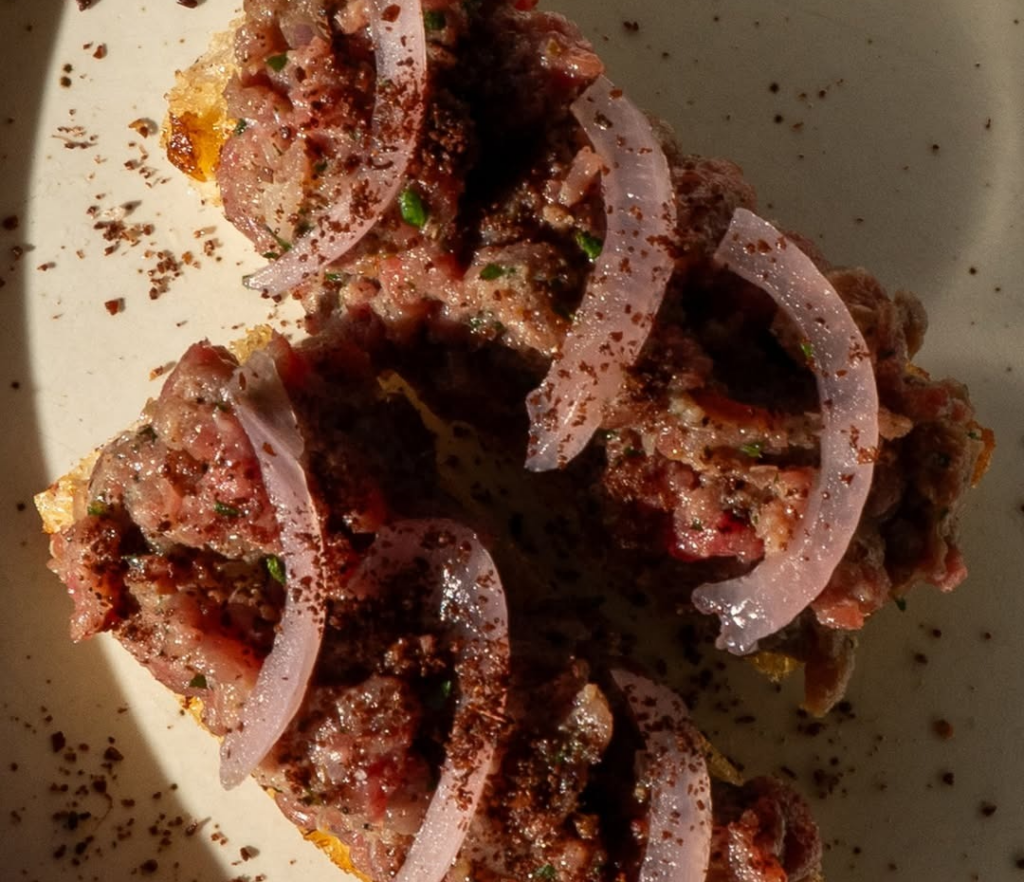
There is plenty of Mediterranean-sounding food in Bali. Hummus on a menu, a feta crumble on a salad, the occasional lamb dish framed as Greek. Most of it is loosely inspired at best — the kind of cooking that borrows the vocabulary without understanding the grammar.
Then there is AMA by Ours in Uluwatu. AMA is not a restaurant that happens to have a few Greek dishes. It is a kitchen built around a genuine Greek-Italian Mediterranean identity, running the same farm-to-table, no-added-sugars philosophy across every service from breakfast to dinner. If you are looking for real Greek food in Bali — dishes that would be recognisable in Athens, made with the discipline those dishes actually require — AMA is the only place in southern Bali doing it properly.
Here is what that means in practice.
What Makes Greek Food Actually Greek
The problem with Greek food outside of Greece is that it is usually reduced to a handful of props: tzatziki, pita, maybe some olives. The actual depth of the cuisine — the way acid, fat, and heat are balanced; the role of fermented and preserved ingredients; the restraint that makes the best Greek cooking taste cleaner than almost any other Mediterranean tradition — rarely survives the journey.
Proper Greek cooking is built on a few hard principles:
- Olive oil is not a garnish. It is a structural component. The best Greek dishes are defined by the quality and quantity of oil used, not reduced to a drizzle for presentation.
- Acid is earned, not added. Lemon, pomegranate, preserved lemon — Greek food uses acid to cut through fat and richness rather than seasoning things into softness.
- Char and fire are techniques, not theatre. Souvlaki, flatbread, grilled vegetables — the wood-fire is doing real cooking work, not just leaving grill marks for photographs.
- Dairy does specific jobs. Feta is not just salty cheese. Labneh, Greek yogurt, mascarpone, ricotta — in a Greek kitchen each has a precise purpose tied to texture and temperature.
- Sharing is structural. A proper Greek meal is not a sequence of individual plates. It arrives in waves, in the middle of the table, and the meal is shaped by conversation and appetite rather than a set order.
These are the principles that AMA by Ours actually applies. They are not claimed in a mission statement — they show up in the food.
The Greek Dishes at AMA by Ours Worth Knowing
Rather than list everything on the menu, these are the dishes that best demonstrate what distinguishes AMA from the restaurants in Bali that use Greek food as an aesthetic:
AMA’s hummus
Hummus is the first test of any restaurant claiming a Mediterranean identity. The version at AMA — crispy chickpeas, sumac, wood-fired flatbread — is made from scratch in the kitchen. The sumac is the tell: it is a distinctly Levantine-Greek sourcing choice that most kitchens in Bali would not have on the shelf, let alone use correctly. The flatbread comes out of the wood-fired oven while it still has heat and char on it.
This is a sharing plate, and it works as one. Order it first.
Halloumi saganaki
Saganaki is one of the more technically demanding Greek starters — the cheese needs the right heat to develop a crust without losing its structure inside. The AMA version uses pomegranate, rocket, and spicy honey, which is a combination rooted in the Aegean tradition of pairing grilled cheese with something sweet and something acidic. It is not fusion. It is how this dish is supposed to work.
Turkish poached eggs
Shakshuka in its Greek interpretation — eggs set in a spiced tomato base with yogurt and flatbread — is one of the benchmarks of a breakfast menu that takes the tradition seriously. The AMA version uses herb yogurt, chilli oil, zataar, caponata, and baked flatbread. The zataar is the detail that matters: it is a spice blend with deep roots in both Greek and Middle Eastern cooking that most Bali cafes either do not stock or do not know how to use. This dish is on the breakfast menu and runs until mid-afternoon.
Souvlaki
The souvlaki at AMA is available at lunch and dinner with chicken or beef, served with rice, fries, salad, hummus, tzatziki, and flatbread. The tzatziki is made in the kitchen — properly strained, properly seasoned. The flatbread is wood-fired. This is the dish that most directly tests whether a restaurant understands Greek street food or is just assembling its components. AMA understands it.
Greek salad
Feta, tomato, cucumber, bell pepper, red onion. Five ingredients, nothing hidden. The Greek salad at AMA succeeds or fails on ingredient quality, and because the kitchen sources from the Ours Farm supply chain, the produce is noticeably better than the standard supermarket-quality vegetables that most Bali salads are built from. The olive oil matters here too — it is used generously rather than as a finishing suggestion.
Watermelon with Greek yogurt
Toasted sesame, olive oil, mint. This is a traditional Aegean combination — the sweetness of watermelon cut by the acidity of yogurt and lifted by the sesame and oil. In a lesser kitchen it would be an Instagram prop. At AMA it functions as a palate reset between richer dishes, which is what it is designed to do.
Where the Italian Half Fits
AMA describes itself as a Greek-Italian restaurant, and the Italian side of the menu is equally serious — wood-fired pizza, homemade pasta, a wood-fired grill section that pulls from both traditions. The full picture is available on the AMA by Ours menu.
The Greek and Italian halves of the menu are not in competition. They share the same foundational logic: fire, good olive oil, fresh pasta and bread made in the kitchen, dairy used with precision, proteins cooked over real heat. The Mediterranean thread holds both sides together, and eating across the menu reinforces rather than confuses the identity.
The truffled ricotta ravioli alongside the halloumi saganaki is not a confused menu. It is what a meal in a coastal Italian-Greek town actually looks like.
Farm-to-Table Greek Food: Why the Sourcing Matters
Greek cuisine is one of the most ingredient-dependent cooking traditions in the world. It does not rely on complex technique or long-cooked sauces to hide mediocre produce. A Greek salad made from inferior tomatoes is a worse dish in a way that a French stew made from inferior tomatoes is not. The ingredients are often the dish.
AMA sources ingredients through the Ours Group’s farm-to-table supply chain, which means the kitchen is working with produce that reflects what Greek cooking actually requires: fruit and vegetables at proper ripeness, dairy that has not been over-processed, proteins raised without the shortcuts that compromise flavour.
The no-added-sugars philosophy that runs through AMA and its sister venue Mood by Ours also aligns with the way traditional Greek food is written. Greek cooking is not a sweet cuisine. It uses honey — specifically and intentionally — but the base flavours are savoury, acidic, and smoky. A kitchen that does not rely on added sugar to round off its flavours is a kitchen that has to get those flavours right from the ingredients and the technique.
This is why the food at AMA tastes the way it does. It is not about the label. It is about what the label requires the kitchen to do.
A Note on Greek Food in Bali Generally
Bali’s dining scene is genuinely world-class in certain cuisines — Indonesian regional food, Japanese, and more recently a strong Southeast Asian-Western fusion category. Greek food is not one of its strengths.
The reasons are practical: the spice profile of Greek cooking (oregano, zataar, sumac, preserved lemon) does not overlap with Bali’s local market supply chain. Halloumi, good feta, and proper labneh are not widely available at the quality needed for cooking with them rather than just presenting them. Wood-fired ovens capable of the temperatures Greek flatbread and pizza require are expensive to run correctly.
AMA has solved all three of those problems. The spices are sourced specifically. The dairy quality is maintained through the group’s supply relationships. The wood-fired oven runs properly, at the temperatures that produce the char and crust that distinguish this kind of cooking from oven-baked approximations.
That combination — the right ingredients, the right equipment, a kitchen that understands the tradition — is what makes AMA genuinely different from anywhere else currently serving Greek food in Bali. It is not a matter of opinion. It is a matter of what the other options are.
Planning a Greek-Focused Meal at AMA by Ours
If you are coming to AMA specifically for the Greek side of the menu, these are the dishes that make the most sense to build a meal around:
For a shared lunch
- AMA’s hummus to start — wood-fired flatbread, sumac, crispy chickpeas.
- Halloumi saganaki alongside.
- Souvlaki as the main — chicken or beef, with the full spread of tzatziki, hummus, and flatbread.
- Greek salad as the lighter counterpoint.
- Watermelon with Greek yogurt to close.
For dinner
- Turkish poached eggs if you arrive on the earlier side and want something from the crossover menu.
- Layered truffled potato as a dinner-only starter — whipped truffle ricotta, parmesan. This sits at the Italian-Greek boundary and is one of the strongest dishes on the dinner menu.
- Spicy tiger prawns from the sharing section — nduja butter, chipotle sauce. The nduja is an Italian component but the preparation sits comfortably within the broader Mediterranean frame.
- Souvlaki or grilled barramundi as the main, depending on whether you want the Greek street food experience or something lighter from the grill.
The full menu is available to browse on the AMA by Ours menu page before you visit.
Frequently Asked Questions
Is AMA by Ours the only Greek restaurant in Bali?
AMA by Ours is currently the most credible Greek-Italian restaurant operating in southern Bali, and the only one in the Uluwatu area with a kitchen built specifically around the Greek-Italian Mediterranean tradition. Other restaurants in Bali may offer individual Greek dishes, but none have the same depth of menu, kitchen infrastructure, or ingredient sourcing that AMA brings to the cuisine.
Is the Greek food at AMA authentic?
AMA does not describe itself as a replica of a specific Greek regional tradition — it is a Mediterranean restaurant drawing on both Greek and Italian culinary roots in a contemporary kitchen. What makes it authentic is not a claim to geographic purity, but the correct application of the techniques and ingredients that define Greek cooking: wood-fired heat, proper dairy, acid-forward flavour profiles, and sharing-plate service. Those things are present and correctly executed.
Does AMA serve Greek food for breakfast?
Yes. Several dishes on the breakfast menu draw directly from Greek and Middle Eastern traditions — the Turkish poached eggs with zataar and herb yogurt, the halloumi options, the Greek yogurt in the granola and the watermelon dish. Breakfast runs until mid-afternoon.
Where is AMA by Ours located?
AMA by Ours is at Jl. Labuan Sait No. 315, Pecatu, Kuta Selatan, Badung, Bali — on the main road into Uluwatu before the Balangan Beach turnoff.
Do I need to book?
Walk-ins are welcome when space allows, but AMA is consistently busy, particularly for dinner and on Monday evenings when the Pizza Monday event runs. If you are planning a specific meal — especially a larger group or a weekend dinner — booking in advance is the more reliable approach.
Come and Eat Properly
Greek food in Bali is hard to find at the level it deserves. At AMA by Ours, the kitchen is doing the work that the cuisine actually requires — the right ingredients, the right fire, the right understanding of what makes this food worth travelling for.
Browse the full menu and book your table here.